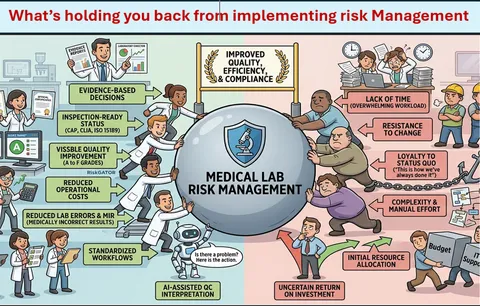
What’s holding you back from implementing risk Management?
Pushing harder for risk management in medical labs is completely missing the point. If you want real change, pushing harder isn't the answer. Removing what is blocking you is.
Read more →Pushing harder for risk management in medical labs is completely missing the point. If you want real change, pushing harder isn't the answer. Removing what is blocking you is.
Read more →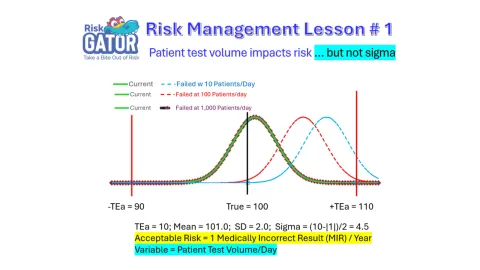
Risk Management Lesson #1 Feb 10, 2026 Does a 4.5 Sigma score mean your lab is safe? Not necessarily. It’s a question every lab professional should be asking. For years, we’ve aimed for high sigma values, believing
Read more →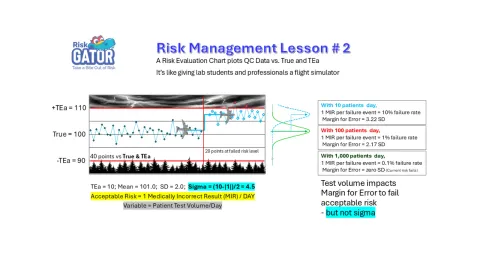
Risk Management Lesson #2 Feb 12, 2026 Imagine a world where airline pilots learned to fly on live passenger flights! Unthinkable, right? Yet, in medical laboratories, we expect technologists to manage patient risk witho
Read more →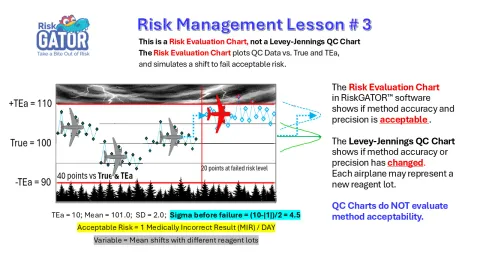
Risk Management Lesson #3 Feb 20, 2026 Risk management is a paradigm shift from statistical quality control. Statistical quality control, Levey-Jennings charts and Westgard Rules are designed to detect CHANGES in analyti
Read more →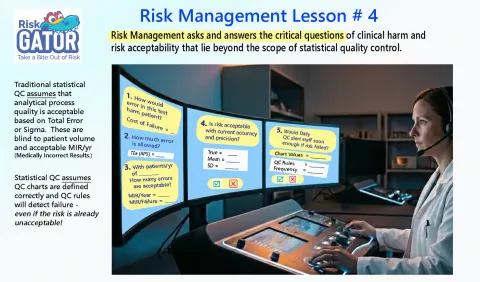
Risk Management Lesson #4 Feb 28, 2026 Risk Management is a science that transcends traditional quality control in medical laboratories . In this risk simulator that models the information in RiskGATOR™ software,
Read more →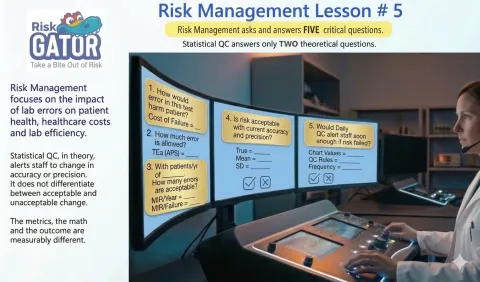
Risk Management Lesson #5 Mar 10, 2026 Risk Management asks and answers FIVE critical questions. How would error in this test harm patient? What would it cost the patient and healthcare system for unnecessary repeat lab
Read more →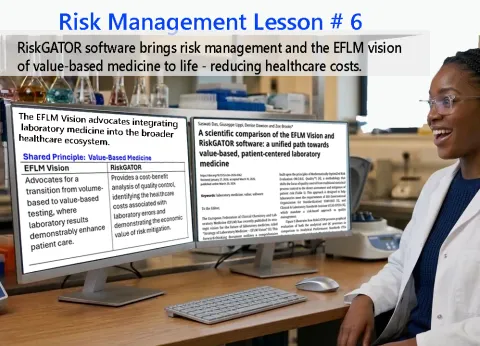
Risk Management Lesson #6 Mar 30, 2026 Risk Management Lesson #6 The scientific comparison of EFLM Vision and RiskGATOR software Finally! The value of the laboratory can be recognized and quantified! Imagine if you could
Read more →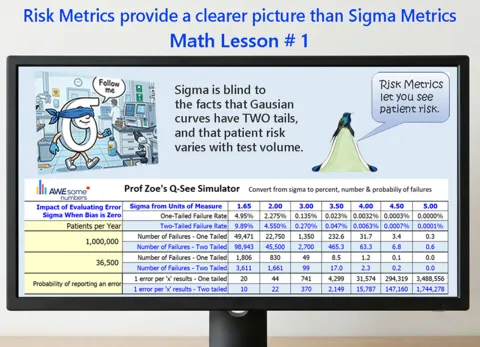
Risk Metrics provide a clearer picture than Sigma Metrics: Math Lesson # 1 Apr 8, 2026 Let’s start this series of math lessons with an AI history lesson on sigma in medical labs. The introduction of Sigma metrics to the
Read more →News Release – Risk Management MasterClass May 14, 2026 We are delighted to announce that our free AWEsome Numbers’ Risk Management MasterClass has been rescheduled to August or September 2026. As we’ve
Read more →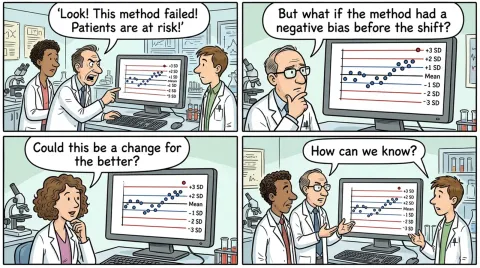
Change vs. Failure May 19, 2026 Change vs. Failure: Are you wasting time and delaying patient results when QC shifts for the BETTER? Do you still assume that all QC flags indicate clinical failure ? In fact, change can b
Read more →