
Risk Management MasterClass
From QC Data to Risk Intelligence
Build on the QC You Already Trust. See More of the Risk It Contains.
October 27-29 2026
A 3-Day Online MasterClass for Clinical Laboratory Professionals
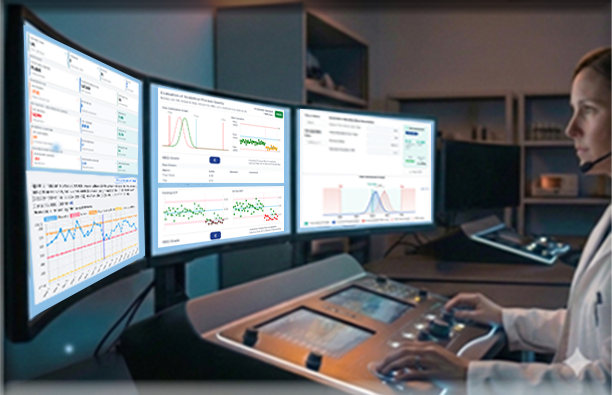
Your laboratory already collects the data needed to understand analytical performance.
But does your current QC process help you answer the questions that matter most?
- How much patient risk does this analytical performance represent?
- Which quality events actually deserve attention?
- How effective is your current QC process at detecting unacceptable risk?
- How can risk information support better, more defensible quality decisions?
Join Zoe Brooks and the AWEsome Numbers team for three days of practical education on moving from statistical QC to risk-based quality management.
No purchase necessary to attend this free MasterClass

Your QC Isn’t Going Away.
It Is Becoming More Informative.
Statistical quality control has transformed laboratory medicine and remains an essential part of laboratory quality.
But today’s laboratories are being asked to look at quality through a broader risk-management lens.
ISO 15189 and CLSI EP23 place risk management within modern laboratory quality practice.
The question is no longer simply:
“Is my process statistically in control?”
It is also:
“What does this analytical performance mean for patient risk—and what should we do about it?”
This MasterClass explores how laboratories can build on the QC processes they already use to answer those questions.
What You Will Discover
Over three days, we will follow a simple progression:
Day 1 — EXTEND
From Statistical QC to Risk-Based Quality Management
Understand why risk management has become an important part of modern laboratory quality and how it complements the QC practices laboratories already have.
Day 2 — INTERPRET
From QC Statistics to Risk Intelligence
Explore what your QC data can reveal about patient risk when analytical performance is considered alongside Total Allowable Error, patient volume and other risk factors.
Day 3 — OPERATIONALIZE
From Risk Intelligence to Better QC Decisions
See how risk information can be translated into practical quality decisions, including evaluation of whether a QC process provides the protection it is intended to provide.
By the end of the MasterClass, you won’t simply know more about risk management. You’ll have a clearer way to think about the relationship between QC, risk and patient care.
Day 1 — EXTEND
From Statistical QC to Risk-Based Quality Management
Why does a laboratory that already has QC need risk management?
Statistical QC remains foundational.
Risk management adds another dimension: understanding the potential consequences of analytical performance and determining whether the risk is acceptable in the context of patient care.
On Day 1, you’ll explore:
- Why ISO 15189 and CLSI EP23 bring risk management into the modern laboratory quality framework.
- How risk-based quality management complements established QC practice.
- What questions risk management adds to traditional QC review.
- How Total Allowable Error connects analytical performance to clinically meaningful limits.
- Why a laboratory’s risk-management process should be practical, documented and actionable.
Your Day 1 takeaway:
“I understand why risk management is an extension of quality control—not a replacement for it.”
Day 2 — INTERPRET
From QC Statistics to Risk Intelligence
Your QC data may contain more information about risk than you are currently using.
What happens when we look at analytical performance through a risk-based lens?
Consider the factors that can change the consequences of analytical variation:
Patient volume.
Total Allowable Error.
Bias.
Standard deviation.
Acceptable risk.
Now consider how the same statistical performance can produce very different patient-risk implications under different conditions.
We’ll use interactive examples to explore:
- How risk changes even when Sigma does not.
- Why errors-per-million-results can be difficult to translate into operational meaning.
- How analytical performance can be expressed as the estimated frequency of medically incorrect results.
- Why “one error every 25 years” communicates something very different from “one error every 5 years”.
- How risk information can help laboratories distinguish what deserves immediate attention from what does not.
Your Day 2 takeaway:
“I can look beyond the QC statistic and understand what the performance may mean in terms of patient risk.”
See the Difference for Yourself
What Happens When You Change the Risk?
Our interactive risk simulator allows you to explore how changes in factors such as:
- patient volume
- Total Allowable Error
- bias
- standard deviation
- acceptable risk
can change the resulting patient-risk picture.
And here’s the important part:
The Sigma value can remain the same.
Yet the operational risk can change.
That is the kind of relationship you need to see—not simply be told about.
During the MasterClass, you’ll see how risk can be expressed in terms people can understand:
One medically incorrect result every 25 years
One medically incorrect result every 5 years
One medically incorrect result every 8 hours
Which one would you prioritize?
That’s the difference between having a statistical result and having risk intelligence.
Day 3 — OPERATIONALIZE
From Risk Intelligence to Better QC Decisions
Understanding risk is only useful if it helps you make better decisions.
On Day 3, we’ll connect the concepts from the first two days to the practical laboratory workflow.
You’ll see how risk information can support:
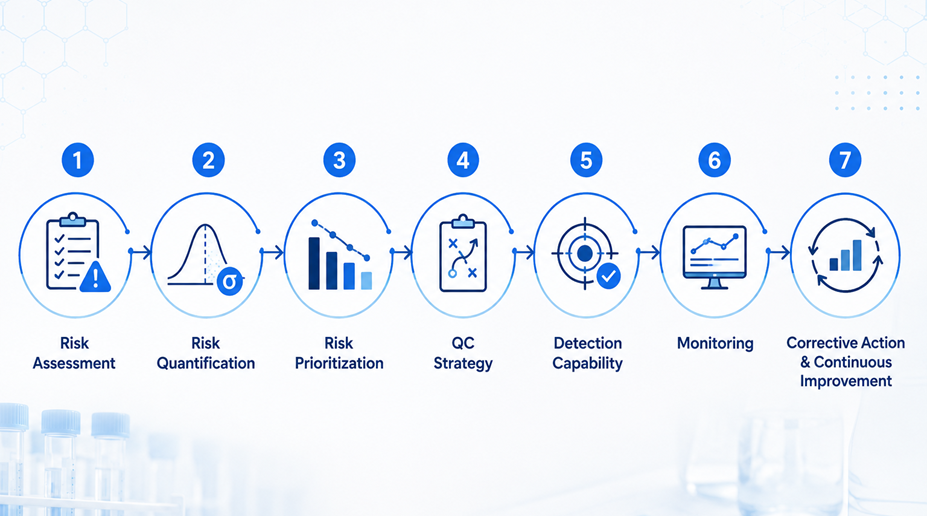
We’ll explore:
- How risk information can guide QC strategy.
- How to evaluate whether a QC process provides the protection it is intended to provide.
- How laboratories can prioritize quality effort where it matters most.
- How risk information can be communicated across different laboratory roles.
- How technology can make risk-based quality management more consistent and practical.
Then we’ll show you what this looks like when the process is operationalized.
Your Day 3 takeaway:
“I understand how risk information can become part of the way we make better QC decisions.”
What You Will Gain From the MasterClass
Practical knowledge you can take back to your laboratory
1. A clearer understanding of risk-based quality management
Understand how risk management fits alongside the QC practices your laboratory already uses.
2. A new way to interpret QC data
Learn how analytical performance can be translated into information about potential patient risk.
3. Better risk prioritization
Understand why not every quality event deserves the same level of attention—and how risk information can help identify priorities.
4. A more intuitive way to communicate risk
Move beyond technical statistical language when explaining the potential significance of analytical performance to colleagues and leadership.
5. A framework for better QC decisions
Connect risk assessment, risk quantification, QC strategy and monitoring into a more coherent quality-management process.
6. A practical look at operational risk intelligence
See how technology can support the risk-management process without requiring laboratories to abandon the QC workflows and knowledge they already have.
Who Should Attend?
Laboratory Professionals
Medical laboratory scientists, technologists, supervisors, and managers looking to master risk management
Quality Leaders
QA/QC coordinators, laboratory directors, and pathologists responsible for quality and patient safety
Forward-Thinking Leaders
Anyone seeking to implement value-based laboratory medicine and quantify ROI of quality improvements
You will get the most from this MasterClass if:
You already use statistical QC—and want to understand how risk-based thinking can make that QC more meaningful.
You are preparing for or strengthening ISO 15189 risk-management activities.
You are working with CLSI EP23 principles or developing risk-based QC plans.
You want to reduce time spent investigating low-risk QC events while improving visibility into meaningful analytical risk.
Why Do You Need This?
RiskGATOR creates a win-win-win for everyone who cares about laboratory quality
Developed by clinical QC experts. Aligned with CLSI EP23A, ISO 15189, and modern risk-based QC principles.

Lower Healthcare Costs
Unnecessary QC tests, repeated analyses from false alarms, and lab errors that lead to wrong treatments all waste healthcare dollars that could be used to help more patients. Traditional QC estimates costs but doesn’t optimize them.
RiskGATOR quantifies avoidable healthcare costs caused by lab errors, evaluates the acceptability of error costs, and recommends improvements to reduce expenses. It guides labs to create QC processes verified to detect failure in a single run—eliminating waste.
Result: Healthcare systems save money on QC materials, staff time, and patient care—redirecting resources where they’re needed most.

Happier Lab Professionals
Lab professionals spend countless hours investigating false-positive QC flags, repeating tests, and dealing with processes that assume “QC processes are effective” without verification. This creates stress, burnout, and wasted time on problems that don’t actually threaten patient safety.
RiskGATOR reduces false positive QC flags and guides you to focus on real risks. It analyzes QC data to advise if an analytical process actually needs improvement in method accuracy or precision—not just arbitrary sigma values.
Result: Lab professionals reclaim hours each week, reduce stress, and focus on meaningful quality improvements.

Healthier Patients
Every lab error that reaches a patient can delay treatment, lead to incorrect diagnoses, or cause unnecessary procedures. Traditional QC methods remain essential for detecting analytical variation, but statistical indicators alone cannot always quantify patient impact in real time.
RiskGATOR quantifies the actual probability of harm—estimating how often an analytical process could produce one error every ‘x’ hours, days, weeks, months, or years. This means fewer missed errors, more accurate results, and better patient outcomes.
Result: Patients receive safer, more reliable lab results that lead to correct treatment decisions.
AWEsome Numbers’ RiskGATOR empowers laboratory staff to work smarter, more efficiently, and faster by turning complex statistics into clear insights. Our innovative software and proprietary algorithms help standardize quality control, reduce errors, and ensure every result is accurate and reliable.
Exclusive Bonuses for Attendees
Core Questions Answered
The Clinical Impact
- How do lab errors directly create patient harm and increase costs?
The Data Gap
- Which analytical shifts matter most to patient risk?
The Evolution
- How can risk management strengthen existing QC strategies?
The Standards
- What do ISO 15189:2022, CLSI/CLIA, and EFLM recommend?
Acceptable Limits
- How do you define Total Allowable Error that protects patients?
Risk Metrics
- Likelihood of errors vs Sigma metrics: what matters most?
Exclusive Bonuses for Attendees
Interactive Simulator
Change risk drivers for analytical quality and QC effectiveness. Watch real-time impact on patient risk and healthcare costs. Gain a deeper understanding of your data and what affects outcomes.
Paradigm Shift Thinking
Gain New Perspectives
- Learn from global experts about regional challenges with accreditation, QC practice, and lab stress.
- Case studies of reductions in patient errors and lab false positives
- Reduce false positives and simplify lab processes
Interactive Simulator Access
30-day complimentary access to Interactive Risk Simulator to model how QC works and forecast patient risk
Full simulator access
Practice scenarios
Unlimited attempts
Special Pricing
Exclusive discounted pricing on RiskGATOR software
Early adopter pricing
Exclusive discounts
Limited-time offer
50% Discount for 3-hour Online Risk Management Course
Live question & answer time
Video Replays
Free Downloads:
Best Practice Checklist for Quality Control & Risk Management
QC Problem-Solving Worksheet for Root Cause Analysis & Action Planning
Interactive Simulator
Take the blindfold off sigma! Convert sigma to Medically Incorrect Results (MIRs) per year to see how:
-
- variations in acceptable risk impacts Margin for Error (that drives QC process design) while sigma remains constant
- the risk of errors varies with patient volumes while sigma remains constant
- acceptability of risk varies with the TEa value selected,
- Margin for Error and the risk of errors vary with analytical bias, while sigma remains constant
- Margin for Error and the risk of errors vary with method SD
- software can report the acceptability of risk instead of just statistics that you need to interpret
- software can report risk metrics of the number, percent and probability of errors, instead of just statistics
- Margin for Error (the number of SD to unacceptable risk) varies with acceptable risk and patient volume, while sigma remains constant
- Risk Distribution Graphs that show current and failed performance adds meaning add clarity to QC data interpretation
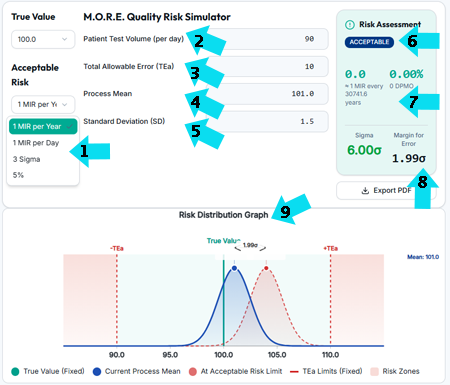
See how risk-based analytics complement statistical QC by translating analytical variation into operational and patient-impact decisions.
Interactive Simulator
Take the blindfold off sigma! Convert sigma to Medically Incorrect Results (MIRs) per year to see how:
-
- variations in acceptable risk impacts Margin for Error (that drives QC process design) while sigma remains constant
- the risk of errors varies with patient volumes while sigma remains constant
- acceptability of risk varies with the TEa value selected,
- Margin for Error and the risk of errors vary with analytical bias, while sigma remains constant
- Margin for Error and the risk of errors vary with method SD
- software can report the acceptability of risk instead of just statistics that you need to interpret
- software can report risk metrics of the number, percent and probability of errors, instead of just statistics
- Margin for Error (the number of SD to unacceptable risk) varies with acceptable risk and patient volume, while sigma remains constant
- Risk Distribution Graphs that show current and failed performance adds meaning add clarity to QC data interpretation
The Assumptions Behind Today’s QC Decisions
Recognize any of these?
The PT Fallacy
- “My proficiency testing is good, so quality is acceptable.”
The Detection Myth
- “I believe our current rules detect failure immediately.”
The Sigma Trap
- “QC rules and frequency can be based only on sigma.”
The SD Error
- “You should combine several reagent lots to establish method SD.”
The Global Perspective
Learn how ISO 15189:2022, CLSI/CLIA, and EFLM regulations are driving the shift toward Risk Management worldwide.
USA | Canada | Europe| India | Asia | Latin America | Africa
What You Gain
-
-
-
-
- Reduce False Positives:
Stop wasting time chasing false alarms. - Staff Empowerment:
Make quality/risk management easier to understand and execute. - Patient-Risk Visibility:
See how analytical variation translates into medically incorrect results before patient harm occurs. - Operational Decision Intelligence:
Turn sigma, bias, SD, and TEa data into clear action thresholds your team can execute with confidence. - Smarter QC Scheduling:
Learn when additional QC adds protection—and when it only adds cost, delay, and alarm fatigue. - AI in the Lab:
Learn how AI improves just-in-time understanding and guidance. - Accreditation Confidence:
Document QC decisions with risk-based evidence aligned with ISO 15189, CLSI, and global best practices. - Confidence to Innovate:
Learn how to strengthen QC decisions using risk-based evidence—without abandoning proven statistical methodologies. - Discount for Certification Course: Self-paced deep-dive Risk Management training program.
- Reduce False Positives:
-
-
-
Join the Evolution of Quality Control
Extend proven QC science with real-time operational risk intelligence.
Upgrade your quality systems, reduce stress, improve patient safety, and lead the next generation of laboratory excellence.
Your Instructor and Moderator

Zoe Brooks
Co-Founder & CEO, AWEsome Numbers Inc
Building on decades of statistical QC science, Zoe developed the M.O.R.E. (Mathematically-OptimiZed Risk Evaluation) methodology to connect analytical variation with operational and patient-risk decision making.
Zoe is a globally recognized authority on laboratory risk management and quality control. Author of “Performance-Driven Quality Control” (AACC Press), multiple articles and scientific posters including the Award Winning “Impact of Seven Incremental Scenarios of QC Strategies. Her M.O.R.E. methodology powers AWEsome Numbers’ RiskGATOR software. (see more)

What happens next?
We’ll send you event details, access links, and information about your exclusive bonuses!